Becoming An Other
The Orchids
They had a majestic burgundy colour with a touch of mustard and fuchsia in the middle, unlike any other orchids I'd seen. I brought them home last year on my birthday, after a gloomy day in Kew Gardens where everything was performative. I had made myself get up, wear my green dress, do something for the sake of doing something whilst every single move hurt.
Perhaps I could tend to them, live at that simpler frequency, where all that is needed is light and water and time, and all that is given back is the turning of leaves toward the sun. The uncomplicated fact of growing.
The blooms lasted a few weeks and then fell off, and then there was only the stem. Eventually that too dried out and all that was left were the leaves, and new ones kept pushing out, so life went on.
But soon there was rot in the roots, which I cleaned up, and then there were gnats that I got rid of, and the bark was not good enough so I replaced it, and then the roots started dying out so I got special orchid moss and covered the failing leaves with a plastic bag to create a humid dome to help growth. But my orchids died.
Tokyo I: Enthusiasm
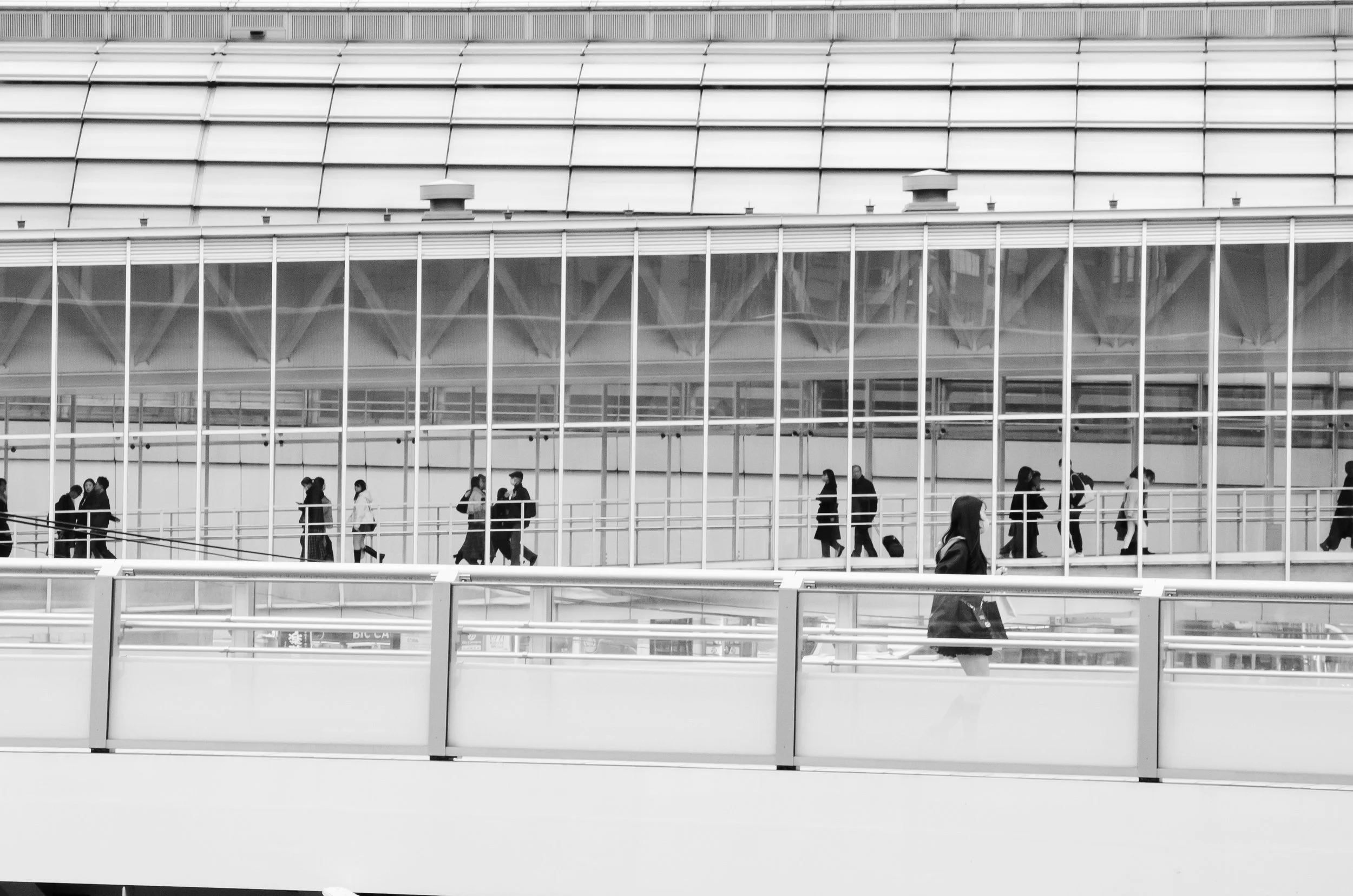
There's a narrow street somewhere in Tokyo, with completely forgettable low-rise buildings, a small store, a parking alley with vending machines beaming as the light of day fades, that crosses a busy avenue somewhere in the distance. From the quiet, I observe the passing cars and trucks and minivans — a completely random progression of vehicles, containing people with entire lives behind and ahead of them. And I am the witness, for just a few seconds, of their passing through that particular street, on that particular but completely unimportant evening. And who knows what kind of day it is for them, whether it is the day they got married, they lost someone, they started a new job, or just another uneventful one in the sea of uneventful days that is our life.
My first visit to Tokyo had nothing mundane about it. I arrived open in a way I hadn't been in years. Not because of the city, though the city helped — its strangeness gave permission. There are places and people that allow you to put things down, if only for a moment, because you are too far from home to carry them. Tokyo was that, the first time.
It was all excitement and anticipation and discovery — ideas for things to do, lists of things to try. Everything felt fragmented and overwhelming, and the mind worked hard to make it cohere. And the city resisted. It was a place that was utterly unfamiliar to me: the signs, the language, the composure of the people around me, the narrow forgettable streets. It offered itself in pieces, and the pieces were enough.
For the first time, I grasped what it meant to be an Other: present but unaccounted for, a witness to lives that required nothing from me. We theorise, share experiences and read travel guides, but in the end we each arrive as ourselves. Discovery is a lonely experience.
Tokyo II: Repair
The second time, I could sense it in the humidity on my skin and the clouds in the sky. In the pine trees that looked familiar, but not quite the same as in the Mediterranean, and the cicadas that sounded similar, yet not exactly the same as where I come from.
I could taste it in the food, with ingredients I wouldn't know how to cook without following a recipe religiously, and the tips of the chopsticks placing a ball of rice on my tongue. I could see it in the temple rooftops against the concrete of the surrounding buildings — the ancient and ultramodern, the traditional and the brutalist — a story that doesn't announce itself but simply coexists, the way things that have survived long enough eventually learn to.
That second time I did not choose a special vantage point like Tokyo Tower, as I had the first time. But I was able to take in more of a city that looks completely ordered and efficient, yet at every turn has layered chaos unravelling. It feels intensely private and intensely collective.
I was able to look up close at the pebbles in the Five Lakes region around Mount Fuji and the layered earth some of them carried, and travel back to my fourteen-year-old self taking in the volcanic black beaches of Santorini, finding familiarity in the unfamiliar. And I noticed patterns in a language fundamentally foreign to me: I didn't speak it, couldn't read it, but I could feel it beginning to make sense at the edges — the way -ko at the end of a word means lake. Kawaguchiko. Saiko. Yamanakako.
The second time was quieter. Less dazzling and more true. The city had become something I could be inside rather than in front of — and so, for a time, had everything I had brought into it with me. It was whole.
Tokyo III: Closure
I landed for the third time over a year later, the culmination of two years' worth of work compressed into two days. My entire team was there: new people I had met, others I had grown closer to, and others now estranged over this two-year arc. Tokyo III was not about discovery or exploration; it was about delivery — and deliverance.
I did not get to see the city or its outskirts. Instead, there were 5am alarms, team briefings, random walks between the Hilton and the Grand Nikko in Odaiba, and quick runs to the 7-Eleven outside the hotel for a bite when there was no time for breakfast.
Beyond the fast rhythm of those few days, the image that has stayed with me is the Fuji TV building, glimpsed from different angles: a structure that felt almost violent against the beach and the bridge. An abandoned spaceship that had landed there with absolute conviction and no apparent purpose. I remember imagining walking up its stairs and feeling immediately, instinctively small — the kind of small that doesn't pass. It made no concessions to its surroundings. It simply stood there, otherworldly and indifferent, and I stood in front of it feeling exactly as alone as I was.
I don't know exactly what unsettled me so much about this structure. Perhaps its sphere suspended mid-air like something that had fallen from elsewhere and never quite landed, or the sheer volume paired with the specific materials — as though the building itself was insisting on its own existence. In my mind's eye, it had the shape and the size of grief.
On my last day, returning from a brief stroll in the city, I looked out of the monorail window as we crossed the bridge I had seen every day from the hotel, and there was the building. From a distance, I thought, it wasn't that bad or unintegrated. It was part of the wider view, perhaps a bit of an odd tone in the landscape, but nevertheless a part of Odaiba and its oddness: the robot, the miniature Statue of Liberty, the shopping malls. A part of life.
Perhaps that is what distance does. Not enough to make something disappear, but enough to change the proportions. What had seemed impossible to place became, from afar, one thing among many. And in seeing it differently, I realised how differently I had come to see.
The Pot
There is a particular kind of grief in discovering that the world does not reorganise itself around what has happened to us. The buildings remain. The trains arrive. Someone buys coffee at 7-Eleven at 5:12 in the morning, a couple argues quietly on a pavement, a child presses their face against a window. Somewhere, someone is devastated, and somewhere else someone is elated. The city contains all of it without resolution.
The pot that once held my orchids is still sitting on the stand next to my couch, still holding the bark and the moss and my best efforts. It is a container of grief and of hope — maybe I will try again with new flowers, or find some other purpose for it. But life still happens around it; days come and go, and the moss still soaks up the sun.
Grief is not something that strikes from outside life, entirely separate from it. Moving forward does not signal the disappearance of what hurt us. Not even necessarily the acceptance of it. It is quieter: the gradual discovery that what once seemed impossible to place can, eventually, find its position in the landscape of a life. The recognition that it is part of the mundane, the everyday: part of us and what we carry as we move along our imperfect, non-linear paths. It makes us ourselves as much as strangers to ourselves, as the coordinates of our psyches shift. There are parts of us we had never needed before: a part that endures, another that can witness without intervening, and yet another that can live alongside an absence without making the absence disappear.
The first time, I stood outside Tokyo and looked in. The second time, I found a way to live inside it. The third time, I barely saw it at all — I was there to finish something and leave. Yet somehow, that was when the city gave me its most important lesson. Not what to leave behind, but what to see differently in a landscape that stays.
In the end, Tokyo taught me how to become an Other.
