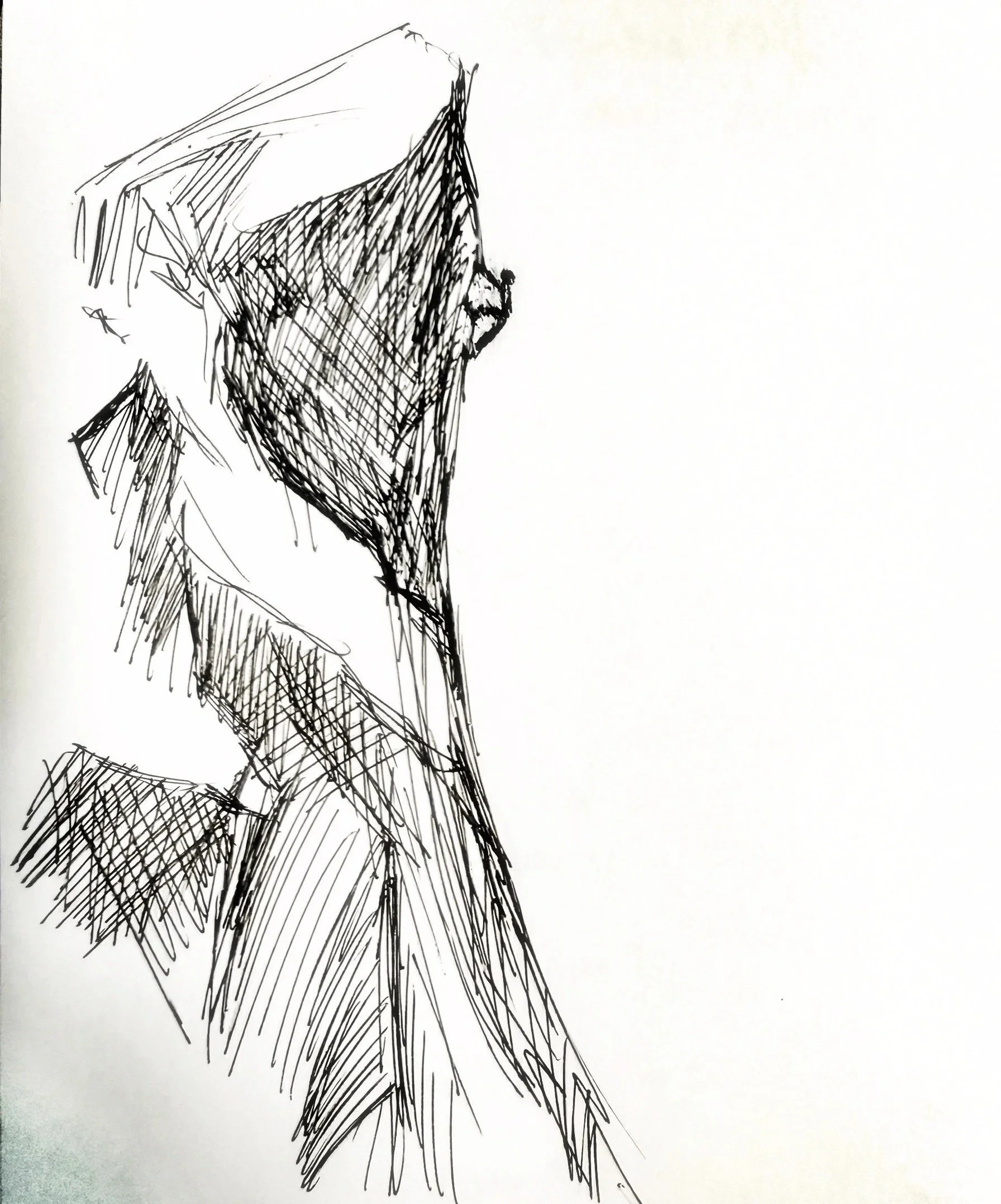
How nervous systems, stories, and institutions learn to carry risk.
1. The Endless Scan
The unconscious mechanics of threat and expectation
Your nervous system is in a state of continuous, rhythmic motion, scanning the environment for patterns and anomalies. It is a relentless unconscious process that some call neuroception, which occurs long before a thought is ever formed. You feel it when your shoulders tense as someone walks behind you, or when your attention snaps to a sudden change in tone. Over an hour, this makes tens of thousands of silent checks; over a day, hundreds of thousands. Over a lifetime, it becomes the background architecture of personality.
In a sense, what we call personality is the accumulation of answers to the question of safety, learned not through reflection, but through repetition. Vigilance, withdrawal, control, appeasement: these are not traits so much as deeply ingrained strategies. They are the risk-management protocols of a body that has already mapped its world.
While personality is a complex tapestry of temperament, chromosomes, and neurons, it is also, in a profound way, the story of how the body has learned to manage the threat of the unknown — what it has learned to expect as it constantly seeks to answer fundamental questions on how we relate to our environment: Is this safe? Is it predictable? Do I move closer or keep my distance? Do I belong?
2. The Tribal Fire
Myth, gossip, and safety as a shared immune system
Danger is something we feel much more than something we understand or rationalise. Our learned lessons throughout history have been emotive and mythological. We have encountered angry wells, poisonous night air, and haunted trees.
Humans are, by design, social creatures. Society, the formation of communities, is a survival strategy. We live in numbers and thrive in the stories we create and the conversations we have. We have long relied on the social ledger of gossip—a survival mechanism that allows us to share complex social information. Who can we trust? Which area is safe? Who is a cheater?
We create ghosts to keep children away from dirty water. We create monsters to keep the tribe safe from falling trees, snakes, and malaria-carrying mosquitoes. In our search for safety, we turn a biological scan into a narrative spell. In that sense, when we talk about safety culture, what we’re really saying is that culture is safety—it is a shared immune system.
Communities, like bodies, do not fail because they imagine danger. They fail when they can no longer update the stories that once kept them safe.
3. Free Solo
The solitary nature of risk
I recently went for a second attempt to watch Free Solo, the documentary about Alex Honnold’s climb of El Capitan. The first time, I had stopped after fifteen minutes, finding it difficult to empathise with a quest that seemed so fundamentally solitary. But I was curious about the mechanics of his composure.
Brain scans of Honnold’s amygdala, the area typically responsible for processing fear, showed remarkably little activation when he was presented with disturbing images. It appears his brain operates through a high degree of “top-down control”, where the prefrontal cortex maintains a rigid organisation even under extreme stress. In the corporate language of the mind, his executive department simply refuses to acknowledge the alarms being sent from the ground floor.
Most of us experience danger collectively. Our nervous systems scan, but they do so in conversation with others — through tone, gossip, shared avoidance, inherited rules. Risk, by contrast, is often solitary. Alex Honnold climbs alone not because he lacks fear, but because he has trained his body to carry the entire burden of safety by itself. There is no room for pooled vigilance on a cliff face (or a building). No cultural immune system. Only preparation, repetition, and the narrow margin between movement and death. His is not a rejection of fear, but an extreme containment of it.
Free Solo means to climb free of equipment relying on one’s hands and feet only. It also means to climb alone, without a partner.
4. The Partner vs. The Climb
Freedom, aloneness, and the cost of shared vigilance
What matters here is not the climb itself, but where safety is permitted to reside.
We are all radar stations, pinging the environment for threats, but the climber silences that radar. What does it mean to live in that silence? Is it freedom, or is it a different kind of isolation?
To be a free soloist in life, you have to be willing to let go of the ropes that connect you to others. Relationships are, by definition, a pooled vigilance. They are messy, they add weight, and they require you to care about someone else’s safety scan. In collectivity, safety becomes the common denominator—it does not make for happiness but provides the foundation for it. Without it, we are constantly in survival mode; our nervous systems depleted and wary of our surroundings.
And yet, for some, the reward system is calibrated differently. Where the average brain finds a steady, quiet satisfaction in the predictable and mundane rhythms of a shared life, the risk-seeker’s internal currency requires a higher exchange rate. It is an amplified learning that only triggers when the stakes are absolute. In this light, Honnold’s choice is perhaps a biological inability to hear the music of the mundane—trading the pooled vigilance of the tribe for the silenced radar of the peak, because only there does the brain finally register a reward.
5. The Sneeze and the Cold
Nuclear safety and the imperative of collective action
In the past two and a half years, safety has become the primary syntax of my daily life. Working in nuclear safety is as humbling as it is fascinating — a constant meditation on the invisible architecture required to protect the nuclear core.
A few months ago, while presenting at the IAEA’s Stakeholder Engagement School in Washington, D.C., I found myself thinking about the immune system as a model for what we do. The room itself was a living embodiment of pluralism, with participants from Zambia and Kenya to South Korea and Canada—a microcosm of the global tribe. The goal of international nuclear cooperation is essentially to ensure that if one operator sneezes, the rest of the world doesn’t catch a cold. It is a quiet, technical recognition that in the atomic landscape, there is no such thing as a solitary act.
Alex Honnold describes his climbs as “low probability, high risk”, but the risk is a closed circuit, contained entirely within the margins of his own skin. In nuclear energy, soloing — the act of ignoring the collective stories, the shared protocols, the vital gossip of stakeholder engagement— is a low-probability event with an infinite radius.
Honnold’s top-down control is a personal virtue, a master architect presiding over a silent site. But in a nuclear plant, that same control, if stripped of pluralism and deaf to the invisible workforce of the community, is not a virtue. It is a brittle structure.
6. The Pioneer’s Burden
Marie Curie and the friction burn of discovery before collective safety
Marie Curie remains the haunting archetype of this tension: she stands at the boundary where solitary exposure is undertaken on behalf of a future collective. She was a pioneer who ventured into the glowing unknown of radioactivity, but unlike the modern climber, she did so as an emissary for the collective. She sought a light that could be shared, a discovery that would warm the tribe.
Yet, Curie was fighting a battle against more than just the invisible rays of radium; she was up against the fundamental mechanics of the human brain. What Kahneman calls “System 1”—the brain’s fast, automatic, emotionally charged mode of thinking—is simply the modern name for our ancient ghost-hunter. It is the part of the Endless Scan that prefers a terrifying story to a boring fact, because a story is a heuristic we can carry. System 1 doesn’t wait for data; it reacts to the scent of the monster.
When we hear the word “nuclear”, System 1, our radar, pings with a primal intensity. It doesn’t see the carbon-free energy or the rigorous safety protocols; it sees the angry well and the poisonous night air of our ancestral nightmares. It is a visceral heuristic: Nuclear equals Danger.
Curie carried the burden of being the first to map this danger, but she also faced the impossible task of asking the world to move from the reactive fear of System 1 to the slow, analytical reasoning of System 2. The radiation that eventually claimed her was the friction burn of her discovery—the physical cost of being the first to touch a power that our nervous systems are biologically wired to flee. She entered the heart of the atom so that we might eventually build the collective stories—and the pluralistic systems—necessary to live alongside it.
7. Pluralism as Safety
Shared vigilance in complex systems
If only one person is allowed to define what is safe, the system becomes brittle. Pluralism is not the absence of authority, but its distribution — the shared immune system in action, the gossip that tells us who to trust. This notion goes beyond nuclear, to the ways we respond to innovation, progress, policies, polity itself, and to bearing the responsibility of being a free soloist by cutting the ropes that could lead to others’ potential free fall or being in a partnership that supports each other’s safety.
When more than one nervous system is allowed to register risk, no single one has to remain on constant alert. Complex systems stabilise through overlap: multiple perspectives, partial redundancies, disagreement that does not collapse into fracture. What looks inefficient from the outside is often what prevents failure from within. Safety is achieved not because everyone agrees, but because no single perspective carries the entire burden of vigilance.
8. The Architecture of Safety
From individual vigilance to collective responsibility
This is where our individual “Endless Scan” meets the shared reality of the tribe. If personality is the architecture of our individual safety, then pluralism is the architecture of our shared survival. But this architecture is only as strong as our ability to communicate across difference.
The danger of the Free Solo approach to society is that it ignores the fundamental mechanics of how we process information. When we fail to recognise that we respond to the world with System 1—with heuristics, ancestral fears, and a nervous system that pings for danger numerous times per second—we leave ourselves wide open. This is the fertile ground where influence takes root. It is possible to bypass the slow, analytical reasoning of System 2 entirely, speaking instead to the angry well and the poisonous night air of our primal scans. In this space, success is found not through the presentation of facts, but by hijacking the very architecture designed to keep us safe, turning our instinctive search for certainty into a tool for redirection.
We are not designed for perfect, solitary performance. We are designed for redundancy — for the sneeze and the cold, for the gossip and the ghost story, for partnerships that hold more than one safety scan at a time. Our nervous systems may search for danger constantly, but we only find rest when we stop trying to outrun the world alone and begin moving in rhythm with others.
The Endless Scan is not a burden to be silenced through extreme containment. It is the music to which we dance. And in that dance, in the pluralistic, messy, deeply human work of looking out for one another, we find the only safety that has ever truly mattered.
*A massive thank you to Dimitris Tsantaris for the invaluable feedback and for always challenging me.
